

This piece is free to read without a subscription. It is a review of the new novel The Earthen Dark by Brad Kelly. This piece was acquired by Futurist Letters as part of our initiative to provide more critical coverage of alt lit.
There is a passage early in Brad Kelly’s remarkable novel in which Jim Murray, a disgraced anthropology professor now working deep in the sewers of Detroit, is instructed by his crew leader that the human waste flowing around his thighs is, in some measure, his own. “What makes you think you won’t have to deal with it?” The observation, so casually devastating, doubles as the novel’s thesis. The Earthen Dark is, at its center, a book about the accumulated waste of a life badly managed, and what a man might find if he were pushed far enough underground to face it.
The novel is weird fiction in the classic sense, and Kelly works within the most subtle vein of this tradition: fiction in which the uncanny is less a visitation upon the ordinary than a slow seepage from below it. Kelly shares with Blackwood and Lovecraft the understanding that weird fiction is at its most unsettling when it reveals the strangeness already latent in the mundane. The sewer is not transformed into something terrible; it already was.
The novel opens in medias res, Jim waist-deep in sewage, drilling pilot holes through century-old concrete while his PhD goes unused. Kelly is very good at physical description. The details accumulate with the obsessive precision of someone who has either worked in confined spaces or studied them with alarming seriousness: the neoprene waders handed down “countless times,” the harness pinching flesh as the winch pulls a man up through the chimney of the manhole, the sensation of moisture that might be sweat or might be the city’s waste working through a seam in the rubber. These passages feel like memory, and that solidity, that material weight, is precisely what the novel needs, because Kelly is going to ask a great deal of it before long.
Jim’s fall from academia is rendered with similar concreteness and a moral realism that refuses easy resolution. A confused moment in class, a name mistaken, a cascade of social media outrage, a file of complaints that are exaggerated or invented. Kelly neither exonerates Jim nor makes him simply a martyr of cancel culture. The man has a certain passivity, a flinching quality, that contributed to his circumstances. His colleague Nicholas, whom Jim long regards as a betrayer, turns out to have been quietly working on his behalf the whole time, misread by a man too mired in his own grievance to see clearly. This is the irony of a life, which comes without fanfare.
What distinguishes Kelly’s use of the weird is the specific mythology he excavates. The novel’s epigraphs are drawn from Jim’s own book, the one he has not yet published, called Underneath and Inside. These interpolations are marvels of embedded scholarship, surveying the underground as human imagination has colonized it across cultures and millennia: the Carbon Works where buffalo bones from the Dakotas and the remains of smallpox victims were ground together into dye and fertilizer, the Detroit salt mine a thousand feet beneath the city, the Grand Mound plundered by treasure hunters in the nineteenth century with its contents dumped into the river. The effect is to surround the plot’s action with a vast, accumulating substructure of meaning. Jim descends into the sewer as one who knows what underground spaces have meant to man since before language. The horror of the novel is that knowing does not protect him.
The crew is Kelly’s great achievement of character. The Captain, an Iraq veteran who “resembled the men in old photos of bridges being built,” dispenses instruction with the authority of someone who has simply absorbed too much to waste time on pretense. Ray, large and violent and surprisingly tender, a man of raw competence who could run an excavator better than the specialist operator, keeps a can of tuna in his car in case he encounters a hungry street cat, and grieves for a father he once found in a bar only to be stabbed by him. Wheezy, a man brain-damaged by a fence post years before, with a lazy eye and ancient patience and frightening knowledge. These men are too particular to be mere symbols, but they carry symbolic weight nonetheless, the weight of a working-class competence that the novel regards with respect.
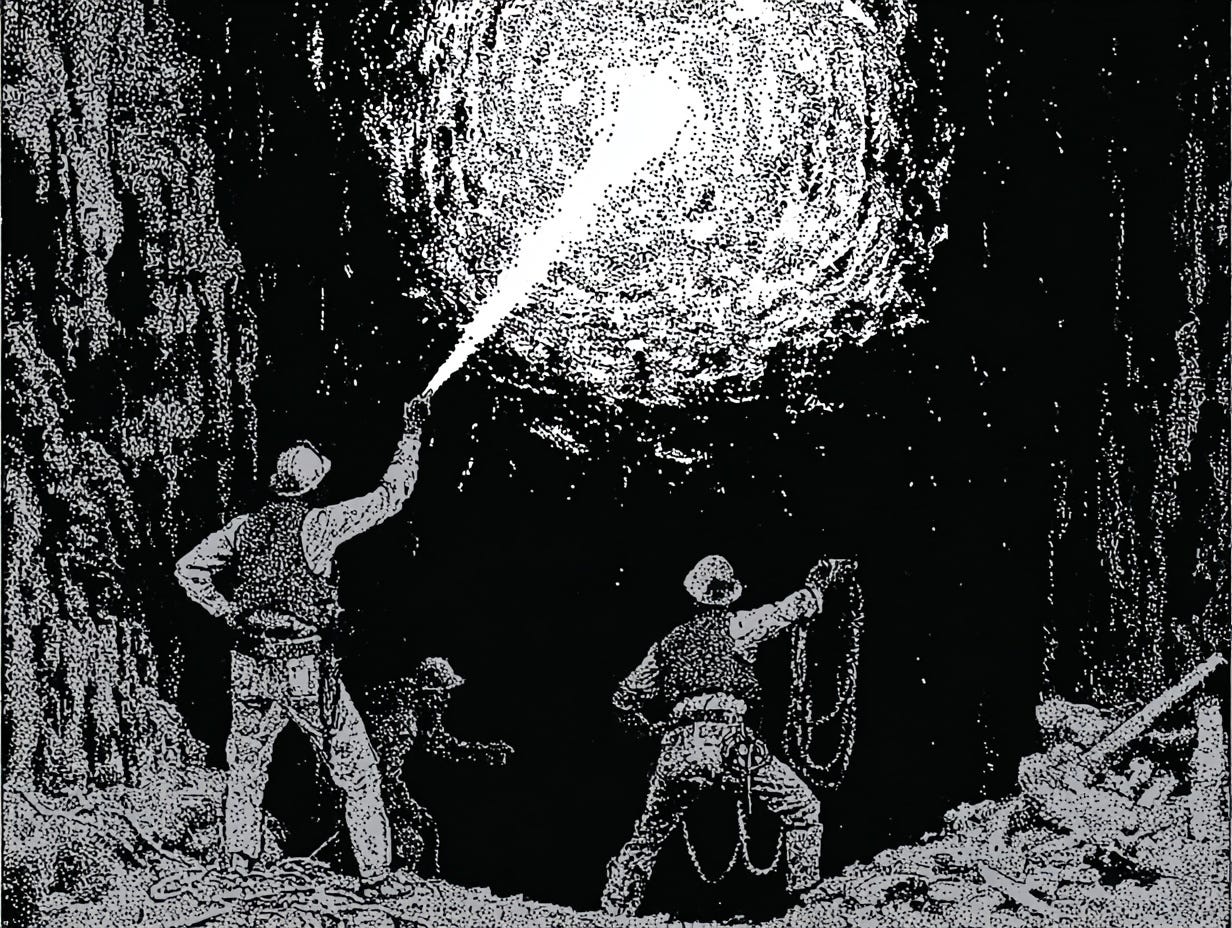
The weird rupture, when it comes, arrives with restraint. A fragment of multicolored light through a hole in the wall of a sewer chamber. A projection, inverted, of a landscape that should not be there. A tunnel of salt running through the deep clay. The reader has been so thoroughly anchored in physical reality that these incursions feel like an ontological seam giving way. Kelly understands, as the best weird fiction always has, that the uncanny is most powerful when it arrives through the most ordinary aperture.
What follows is a sustained ordeal that operates on three registers simultaneously. Literally, Jim and his crew pass through a portal in the earth’s infrastructure and emerge into a city transformed, emptied of its inhabitants, cycling through alternate presents and possible pasts with the logic of a fever dream. Mythologically, the novel is a katabasis in the ancient sense, a descent into the underworld from which the hero may or may not return with a boon. Kelly deploys this framework without reducing it to allegory. His allusions, to Orpheus, to Izanagi, to the Pueblo sipapu, are worn lightly, absorbed into the texture of the prose rather than announced. Psychologically, the novel is about a man confronting the accumulated costs of his failures: professional timidity, passive aggression toward a friend who tried to help him, a tendency to let what he loves slip between his fingers while he studies it.
The novel’s treatment of Wheezy is striking. The brain-damaged sewer worker, a minor figure in the first chapters, becomes, in the underground portions, a figure of truly uncanny wisdom, an old man of the tunnels who has been down here so long he has come unstuck in time. He is the novel’s Tiresias, its Fisher King, and also something more frightening than those comparisons suggest: a warning about what it costs to understand the Grandmother Spider, the intelligence at the root of things. Kelly handles this figure without condescension or false mysticism. Wheezy is still a man who survived a brain injury and a terrible job and tried to make sense of what he found. That he has found too much is not treated as a gift.
The Spider herself, the novel’s ultimate antagonist and deepest mystery, is realized with admirable restraint. Kelly knows that showing can diminish. She is referred to but rarely described. She gives you what you ask for, Wheezy explains, but the wish and the getting are never quite the same. This is cosmological horror, the universe as a trap baited with human desire, but Kelly gives it an American texture. The subterranean world in this novel is that of industrial Detroit, a place where the layers of history are unusually compressed and the bones beneath the street particularly numerous. The horror was here before we were.
Kelly’s prose is hard and plain and does not waste itself. He has an anthropologist’s eye for the revealing detail and a construction worker’s vocabulary for the physical world. His dialogue is a particular achievement: the crew’s speech is idiosyncratic enough to be real without ever tipping into dialect tourism. Ray’s monologue near the novel’s end, in which he describes traveling back in time to find his father in a bar, is the kind of set piece that can only be written by someone who has listened to how men actually speak in extremis.
The novel’s final movement, in which Jim confronts an alternate version of himself in his own house, asks to be read more than once. Resolution appears through acceptance of what was wasted, of what might still be recovered, of the fact that the world is held together by a will that, if allowed to slip, will not be replaced by something better. Jim is returned to something like his life, to Liz’s kitchen and Shelly’s clouds, and the book that is at least now imaginable. Whether this return is earned or granted or simply another fold in the trap is left unspecified.
The Earthen Dark makes demands of the reader. It does not explain its cosmology. It does not resolve its moral questions about Jim’s culpability or his culture’s overreach. It descends into darkness, lingers there, and brings back only what can survive the ascent. Kelly has aptly written it in the key of weird fiction, with its traditions of cosmic indifference and human smallness. These are the genre’s deepest traits, applied here to a story about what it costs to be a husband, a father, and a scholar who had to find his way back underground before he could find his way home.

