

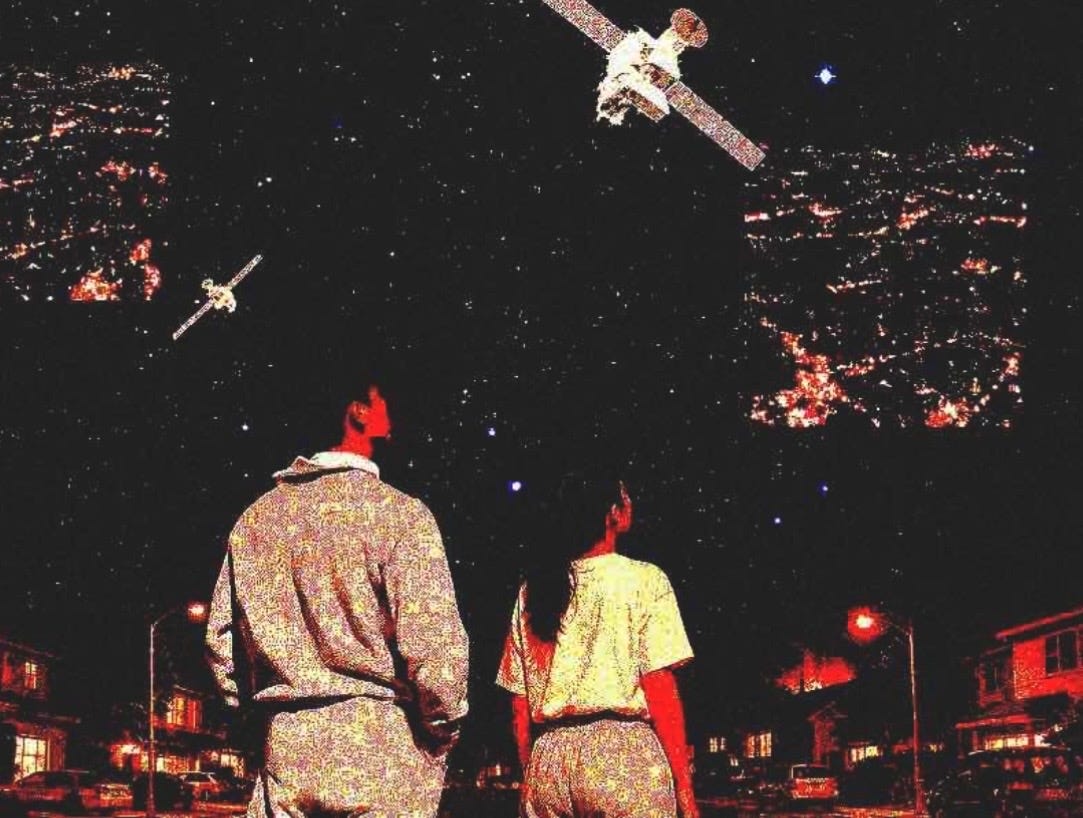
This new fiction from Lillian Wang Selonick is free to read without a subscription. It contains some explicit content.
Due to length, it may be cut off in your email client, but you can read it in full on our website.
Chewie was a dropout, a loser, a degen gamer, but his social awkwardness kept his record clean enough for the boys at Fort Meade to give him a TS/SCI, a badge, and a GS-11 salary. Not that Chewie needed all that money. He lived in a one-bedroom apartment in Odenton, Maryland, a location selected for its proximity to the Fort and a decent Sichuanese carryout, and never went out. Chewie did not cook. The cafeteria at the Fort and Peppercorn Garden, along with big tubs of pea protein powder on auto-delivery, served all of his nutritional needs.
Chewie was actually quite fit. The calisthenics program from r/Bodyweight wasn’t enough resistance to build a lot of muscle tissue, but he was lean enough to have visible abs and was attractive in a wiry, scrappy way, if not in an MCU action star way. Chewie measured his waist every Monday—not out of vanity, but because he knew that Asian men were susceptible to negative health outcomes like diabetes at a relatively smaller waist circumference and visceral fat percentage, and Chewie wanted to live a long time. He wanted to live long enough to achieve transhumanist immortality.
Despite his commitment to health and wellness, Chewie was not a looksmaxxer. He had given up on that path after consulting the race-stratified data published by dating app companies and concluding that, no matter what he did, he would always suffer the Asian male penalty in the dating market. He knew that his personality was not lively and attractive to most girls, but he thought that eventually he would meet a cute, shy, nerdy girl who didn’t care that he wasn’t making $400,000 at a FAANG in SF or saving lives as a cardiothoracic surgeon or whatever. She would probably be Asian, or maybe a hapa. Blasian, even. Chewie wasn’t prejudiced.
Chewie saw some of these cute, shy, nerdy girls on Instagram and TikTok and Substack. They had thousands of followers and made content about their custom-built mechanical keyboards and their morning routines and overcoming social anxiety at Comic-Con. They were pretty and feminine and soft-spoken—exactly the kind of girl Chewie imagined would see past his transition-lens glasses right into his heart. Sometimes he sent them messages or commented on their posts. He knew it was illogical to think that one of them would actually fall for him, but he still got a surge of dopamine with every notification that they had liked his comment. Chewie wasn’t stupid. He knew that their likes were just an engagement strategy.
>>>
Chewie wasn’t his real name. His real name was Thomas Choe. Most Korean immigrants romanized this common last name as “Choi,” but Chewie’s parents had stubbornly clung to the native pronunciation that was closer to “Chway” and had chosen an unusual transliteration. Americans struggled with this pronunciation. “Chewie” was a nickname given to him by his best friend. It was the only nickname he’d ever had.
Chewie’s best friend was a mid-forties DARPA contractor named Joshua Mendoza, the American-born son of dirt-poor Filipino immigrants who struck it rich in trash removal in Northern Virginia. He was a gregarious former spoiled new-money kid who got along with everyone. Joshua didn’t know that he was Chewie’s best friend, and it would have made him sad to learn it. Before he was assigned to the Fort three years ago, everyone just called Chewie “Thomas,” if they spoke to him at all. He liked to keep to himself. But then Joshua strutted in and greeted him with a bewildering fist bump and bestowed upon Thomas the nickname “Chewie”; forevermore, he would be Chewie.
He liked having a nickname. He changed all of his screen names to include the new sobriquet. He liked talking to Joshua about his macros and his training splits. But they had never hung out outside of work, so Chewie was confused when Joshua asked him one day if he wanted to go to happy hour at a nearby taqueria, a Tex-Mex joint operated by Salvadorans. They were two margaritas in before Joshua brought up the reason for the unprecedented hang. Chewie seldom drank alcohol and was feeling warm and spacy. He was surprised by his enjoyment of that sensation.
“So, you been tracking this RIFLE mishegas, bro?” Joshua asked.
“Reduction In Federal and Local Employment, right?” Chewie said. “Heard of it, but I don’t follow politics.”
“I mean, it’s all bullshit, so that’s probably healthier than staying glued to the news,” Joshua said. “But RIFLE is an important one, man. They’re gutting all the agencies. It’s a bloodbath out there.”
“Oh. Yeah. I’ve heard about that,” Chewie lied.
“The thing is, I wanna make sure you’re prepared in case the ol’ RIFLE gets pointed at you, know what I’m saying?”
“I’m too important to get fired,” Chewie said. It was true. Chewie was USG’s top-performing cyberwarrior. He was balletic in the tubes. He was legendary in the very small community of people who were (1) technical enough to grok the complexity of his offensives, (2) informed about the cybersophistication of the United States’ adversaries, and (3) cleared. Chewie was one of a small handful of people in the Western Hemisphere who knew for certain that the North Koreans had a nuclear warhead in orbit, designed not to inflict kinetic damage but instead intended to detonate in the stratosphere, causing a massive, high-altitude electromagnetic pulse, or HEMP, that could permanently cripple most of the continental United States. All electronics would be fried, unusable, for all time. Millions would die, both in the initial wave of plane and car crashes and in the months that followed the collapse of industrial agriculture and medical systems.
Chewie had once lived off the land for over two years inside Kim Jong Un’s personal nuclear launch systems before the breach was discovered and he was forced to brick their servers. They rebuilt, of course, but the regime briefly lost contact with their HEMP nuke in low Earth orbit. Bureaucratic squabbling between risk analysts at the National Security Council and the Space Force squandered the opportunity to permanently disable or retrieve the orbital warhead, but it was still true that the world had been, temporarily, a safer place because of Chewie. And there were many examples of his unsung heroism.
“Bro, I know that, the unit knows that; hell, the Director knows that,” Joshua said. “But these RIFLE jokers, they’re some snot-nosed kids straight out of college, don’t know shit about fuck, coming in and giving half the fucking USG the axe. I’m just saying you need to be prepared.”
Chewie considered this, but it seemed patently impossible to him that any rational actor whose interests were aligned with the US and not her adversaries would ever terminate his employment.
“In this unlikely scenario,” Chewie said, indulging his best friend, “what would I even do? What would anyone do? Our critical infrastructure is essentially pwned by China without me.”
Chewie sometimes fantasized about seducing one of the CCP bots who targeted him. They had sexy AI-generated profile pics and sent him messages about how lonely they were as international exchange students. Chewie never responded to the bots—as an offensive cybersecurity operator he knew intimately that human vulnerability was the weakest link in any system—but he daydreamed about toying with them. Five years ago, some Snowden wannabe had leaked the personnel files for some of the three-letter agencies, so Chewie got targeted a lot.
Because the only girls who wanted to talk to him online were CCP or North Korean bots, Chewie decided that it was too risky for him to date. Even real physical girls could be spies. Even white girls. And so, because Chewie was a patriot, he set aside his desire for love. At least while he was working. He knew how important he was to the United States security apparatus. Even if the American public would never know his name, even if he never won a medal, Chewie was satisfied with the knowledge that he, and a very few others like him, were all that stood between American cyberspace and the total malicious cyber-hegemony of her adversaries. His badge said Analyst, but really he was an operator. The Russians had Fancy Bear, the Chinese had Volt Typhoon; America had Chewie.
“Yeah, dude, I know,” Joshua said. “We’re sitting ducks, fish in a barrel without you. That’s why you gotta come on under me at Simak. RIFLE can nuke 60 percent of fed payroll at will via executive order, but they can’t cancel our contracts. We’re locked in, baby.”
“You want me to work for you at Simak?” Chewie asked.
Simak-Stapledon was the third-largest defense contracting company in the D.C. metropolitan area, just behind Lockheed Martin and Raytheon, but still ahead of nimble AI-native shops like the up-and-coming Bombadil. They were known for their competitive salaries, subpar benefits package, and abysmal IT service center.
“I don’t know,” Chewie said. “I live on Stapledon Avenue. It might feel weird.”
“Bro, that’s the most retarded reason I ever heard to turn down a job offer,” Joshua said. “Half the streets around here are named after some shady firm or another.”
“I guess so,” Chewie said.
“Just think about it, man. Keep it in your back pocket. For the good of the country,” Joshua said. “Simak’ll pay you double what you’re making now. Course, we don’t have those sweet fed bennies, but I prefer cash in hand, anyway. Plus, full disclosure, dude, I get a referral bonus if you get hired.”
Chewie did not think about Joshua’s job offer that night, but he spent a long time thinking about the jokes and drinks they shared. Lying in his full-size bed, staring up at the soft Milky Way projection on his bedroom ceiling, Chewie ran through the entire interaction like he was playing a movie in his head. He smiled at all of Joshua’s jokes, and for once he could find nothing to cringe at in his own lines. It had been a perfect evening. He wondered if it would ever happen again. Chewie fell asleep fantasizing about going on a double date with Joshua, Joshua’s wife, and a beautiful Chinese spy.
>>>
Plink.
Vivian slipped another intact cartridge into the shallow pocket of her ex’s vintage forest green American Apparel hoodie, where it knocked against the others she had salvaged from the wreckage of her bedroom floor. Her knees were red and carpet burnt from these daily excavations. Bits of lint, crumbs, and cat hair stuck to the raw pebbled flesh stretched over the joints. There was no cat. The cat was gone. The cat had left.
Vivian picked up another cartridge from a pile she was pretty sure she had not already checked. Used. Empty. Its tiny silver mouth torn open, a ragged O of dismay. There was no pressurized gas. The pressurized gas was gone. The pressurized gas had left. She cast it aside, then reached for the next.
One in about every twenty food-grade nitrous oxide charger that she checked happened to be intact. Every time she saw a smooth, unpunctured seal on a cartridge’s tapered neck, she felt a burst of brief, intense joy, like how she used to feel when she saw that Gabriel had liked her Instagram story. When she had collected up five, she pushed herself off the floor and climbed back into bed. The stainless steel whipped cream maker was cold against her thigh under the stained blue and yellow quilt her grandmother had made when she was born. There was a cigarette burn in one of the yellow squares. Seeing it made Vivian feel sad and disgusted and angry. She stared at it now to punish herself.
There was no Vivian. Vivian was gone. Vivian had left.
Vivian hated to cook. Most of her calories came from Italian beef sandwiches, delivered by courier from an app. AutoNosh charged exorbitant service fees, but as long as Vivian had the money, she was willing to pay to avoid ever leaving her apartment. She savored the soggy, flavorful sandwiches on French bread dripping with au jus, but even this regional delicacy brought only a momentary pleasure.
Once, Vivian had velocity. She had been on an upward trajectory. She was a naturalized US citizen. She was young and beautiful and was on her way to being highly educated, part of the blessed class of people set to thrive as everyone else foundered in the age of AGI. She had been in one of the world’s top neuroscience graduate programs at the University of Chicago, guaranteed a slot in the priestly caste that tended to the emerging machine god. Her boyfriend was another bright young thing, a postdoc whose computer vision startup was already valued at half a billion.
That was before she had been approached and presented with a credible threat to a branch of her father’s family who still resided in Shandong Province, and she had agreed to be groomed for a position in industry that would present her with access to data that would be very interesting indeed to the Chinese Ministry of State Security. Before she had been stopped at O’Hare International Airport and found to be carrying a terabyte of extremely sensitive proprietary data scattered across a few thumb drives sewn into the lining of her luggage on the way to an academic conference in Beijing. Before the federal charges were dropped due to improper handling of materials, but a preponderance of evidence led a university disciplinary board to expel her from the program.
Vivian lost the stipend, lost the boy, lost her future. She was nothing more than a yoob, now. But her CCP handlers tossed her a bone out of something like pity. They threw her some OSINT analysis work usually reserved for domestic workers and paid her the same pittance. Vivian felt something like gratitude for the meager sense of purpose it gave her to betray her adopted country. She clocked in at night, working Beijing hours. During the days, she chased oblivion until the sun went down, passing the long daylight hours getting high for thirty seconds at a time on nitrous rips straight from the whipped cream maker and mechanically stimulating herself to orgasm until she was raw. She pushed these neurochemical levers relentlessly, with each repetition marginally degrading her ability to feel pleasure, or to feel anything at all, which was the point.
>>>
Two weeks later, on a Thursday morning, Chewie noticed that his low-side Outlook app had logged him out and he couldn’t see his schedule on his work phone. He tried to log back in but got stuck in a loop. It wasn’t a big deal; he usually checked his meetings for the day before he left for the office, but he knew he only had one high-side call at 2:00 p.m. But when he showed up at the gate, his badge wouldn’t scan. The security guard he had assiduously avoided eye contact with for five years had to get on his walkie with the head of the security office to confirm: Chewie was out.
Everyone except Joshua was surprised when Chewie got RIFLEd. The cuts were irrational and erratic, but the whole office thought that someone, somewhere along the chain of command would have vetoed the move. It was too suicidal to axe the one cybersuperweapon in the USG’s arsenal.
Chewie couldn’t believe it. He tried to appeal the decision, but they wouldn’t let him on-site. His badge stopped working immediately. He still had his security clearance, but a sister program to RIFLE, known as Clearing A Path to Intelligence Vital Enforcement by Securing Our Systems, or CAPTIVE-SOS, was being spun up to “address redundancies in the nation’s security apparatus” by canceling the clearances of inactive former government employees and contractors. He would need to find a new job soon to park his clearance to keep it active. It was critical that he act immediately. He needed to call Joshua, update his LinkedIn, start leveraging his network. He should call his mom in Annandale, Virginia.
Instead, Chewie spent the next week playing Fallout 3 for fourteen hours a day. He reveled in the nuclear ruins of CGI Washington, D.C., grinding mole rat kills and side quests and leveling up until he passed out on the couch, cotton-mouthed and dry-eyed from many hours of gameplay. The passage of time within the game felt more real than whatever was going on outside his blackout-curtained windows. Chewie bludgeoned his perceptive faculties with neat, efficient gameplay, leaving no space for thought or emotion. There was only the Wasteland.
Chewie had run through the main storyline and was mopping up some of the remaining side quests when his buzzer rang. He hesitated before launching a grenade at a Super Mutant and the grenade missed its mark. The Super Mutant clubbed him with a tire iron and he died. Chewie swore, rubbed his eyes. He wasn’t expecting a food delivery—or was he? Had he put in an order at Peppercorn Garden in a daze and forgotten about it? He couldn’t remember the last time he had eaten. Chewie took a swig from his Code Red Diet Mountain Dew and set the controller down as he respawned inside Farragut West Metro Station.
When he opened the door, it wasn’t a brusque Laotian AutoNosh delivery driver with his Extremely Spicy Water-Boiled Fish. Instead, it was Joshua, holding a six-pack of Yuengling and a large pizza.
“Oh, hi, Joshua,” Chewie said, a little dazed by the bright fluorescents in the hallway. “Um, come on in.”
Joshua visibly recoiled at the smell inside Chewie’s apartment, a suffocating combination of stale sweat, Mountain Dew fumes, and feet. His eyes flicked over the mess in the living room and the video game menu on the screen.
“Hey, brother, hadn’t heard from you in a minute, so I thought you could use some guy time,” Joshua said with a cheerfulness that almost sounded natural. He set the pizza down on the kitchen counter. “And maybe we can talk about your next move.”
“My next move?” Chewie said.
“Yeah, you know,” Joshua said. “To come on board at Simak.”
“Oh,” said Chewie. He took an offered beer from Joshua. “I don’t know about that. I was kind of thinking I would take a break from work for a while. Sign up for UBI. Maybe, uh, date a little bit.” He opened the lid of the pizza box. Meat Lover’s. Chewie thought about the saturated fats and assorted preservatives in the sausage and pepperoni. He bit into a slice. The cheese was clumpy and beginning to congeal.
“Man, what?” Joshua began to get frustrated. “You want to date now that you’re a broke yoob? You’ve got it ass-backwards, bro. Girls don’t like yoobs. You gotta be making the excess income to buy them sushi and flowers and shit. Any girls worth having, anyway.”
Chewie took his pizza and beer and sat back down in the gamer nest on his couch. The cushions had conformed to his body and a polyester microfiber LEGO blanket retained some of his body heat. Joshua pulled up one of the two folding chairs from the kitchen table. Chewie’s mom had insisted that he buy two chairs, although he had protested that he would only ever use one.
“I can’t date when I’m working for USG,” Chewie said. “It’s too dangerous on the apps.”
“Man, the apps suck anyway,” Joshua said. “They’re full of shallow bitches who string you along for weeks. Any reasonably attractive girl on the apps is incentivized to be a gold-digging cocktease. They’re all just in it for the free meal. You gotta meet a girl IRL. Meatspace.” Joshua’s eyes flicked around the apartment again. “Look, I bet I can find a nice girl for you. My wife has some friends your age. Maybe one of them, maybe we can set you up.”
Joshua pulled out his phone and began scrolling through his wife’s Instagram, looking for group shots with some of her friends. He scrolled a long time, then pointed the screen at Chewie.
“Look, what about her? I think she just broke up with her fiancé . . . she’s a little heavy, but she has a nice face. You like ’em thick?”
Chewie shrugged noncommittally.
“But come on, you gotta be employed,” Joshua continued. “Let me help you out, man. S-S can triple your government rate. You were, what, GS-12? 13?”
“GS-11, step 7,” Chewie said.
“Jesus fucking Christ, they really lowballed you, ya know?” Joshua said. “You’re a national fucking treasure, man. It’s criminal how they did you like that.”
“I was just thinking about taking it easy for a while,” Chewie said. “Working on some hobbies.”
Joshua gave a pointed look at the Flamin’ Hot Cheeto-encrusted Xbox controller and the crumpled-up tissues next to him on the couch.
“Your country needs you,” Joshua said. “Think about it.”
>>>
Vivian was running out of money. Her MSS handlers said they’d be in touch with a new assignment, but that was weeks ago. She had to ration the nitrous, now. It was humiliating. She spent more and more time on her hands and knees, searching the carpet for sealed cartridges. And in the growing spaces of nonoblivion, the long hours during which she had to inhabit her own mind, her thoughts increasingly turned to Thomas Choe.
Vivian hadn’t thought him special, at first. He was just another second-generation Korean American autist with fobby overbearing parents and a light social media presence. Vivian was a half German-American, half mainland Chinese, born abroad and raised in the Inland Empire. She prided herself on having AMWF parents, although she considered it slightly embarrassing that they had met while her white mother was an English teacher in Jinan for a year after college. Vivian thought she knew Thomas’s type. Thomas was a failed striver, the kind of neurotic East Coast Asian American who lacked the confidence to embrace the ascendant hallyu and become socially successful and lacked the ambition to achieve academically and professionally. In spite of his constitutional timidity, Thomas’s special set of skills and obsessions had led him to a position of critical, if unsung and poorly compensated, importance in the US cybersecurity apparatus.
The more Vivian learned about Thomas, the more she thought about him.
It had started as a simple OSINT assignment. Thomas had a very light social media presence and unusually good opsec, but it was impossible to be a true ghost on the internet in this day and age. She read the simp comments he left on various Asian and Wasian female influencers’ posts with particular interest. As Vivian demonstrated proficiency in hoovering up the crumbs of Thomas’s digital detritus, her MSS handlers entrusted her with more and more of their proprietary tools and methods, and Vivian burrowed deeper into Thomas’s life. She hacked his apartment building’s IoT and learned his eating and sleeping habits. Thomas’s apartment did not have a doorbell camera, but the front door of the building did, as well as a couple of other security cameras in the laundry room and storage areas. Vivian owned them easily with a small assist from CCP tech. All day, she huffed nitrous and masturbated, pummeling her clitoris on her Hitachi Magic Wand’s highest setting. All night, she watched Thomas Choe, noted the deviations in his routine, and compiled reports on his behavior. She started to think of him as Chewie.
When her handlers abruptly canceled her contract, they locked her out of all of the tools. Vivian did not read the news, but even she had caught wind of RIFLE, and she put two and two together. Thomas Choe was no longer a target. Thomas Choe was no longer valuable.
At first, Vivian told herself that she missed the money. It had been a nice supplement; she could afford the exorbitant delivery fees on her favorite Italian beef sandwich, which meant she didn’t need to venture outside as much for groceries, and she never ran out of nitrous oxide. A steady supply of drone-delivered clanking packages arrived at her doorstep every two days.
Now, her finances were tight. The yoob couldn’t cover all those delivery fees. She had to actually walk down to the co-op grocery store to keep herself fed. If she wanted an Italian beef, she needed to actually take the bus all the way to 55th and Cottage Grove, order it in person, and eat it in public—a nightmare. Some days, when she ran out of nitrous and didn’t have money for same-day drone delivery, she walked to the vape shop on the corner to buy packets of a foul-tasting powder called krater, which she mixed into a sludgy tea and chugged with her nose pinched. It was an unscheduled opioid-hypnotic extracted from a South American tuber and it often made her vomit up gritty, green-brown bile.
More than the loss of her previous lifestyle, Vivian began to realize that she missed Chewie. She could continue to track him on the open internet, but she no longer had access to his apartment’s camera footage, his smart refrigerator notifications, his wearable tracking data. She missed him more intensely than she had ever missed Gabriel, the flesh-and-blood neuroscience postdoc who had moved out with their book collection and their cat nine months ago. Gabriel was—well, he was a perfect fucking angel, wasn’t he? He never let Vivian under his skin. He never showed her his imperfections, his insecurities, his character flaws. Not like Chewie. She saw all of Chewie’s flaws, and they just drew her in deeper.
But now, there was no Chewie. Chewie was gone. Chewie had left.
Desperate, Vivian messaged her former handler through the darknet dead-drop portal she used to submit her findings through, imploring them to take her back and arguing the continued need to monitor Choe, even now that his federal employment was terminated. The response was swift.
First: they scolded her for using a PGP encryption key that was now weeks out of date and potentially compromised.
Second: they denied her request to be given any additional surveillance work.
Third: they scolded her again for wasting their time, especially now that they were dealing with headaches from Pyongyang.
When the July yoob hit her checking account, Vivian came to a decision. She threw out her whipped cream maker and supply of party balloons. She threw out her Hitachi Magic Wand, wrapped in a dishtowel for modesty. She sold her few remaining household possessions, bought a Greyhound ticket for Baltimore, and broke her lease.
>>>
Chewie had never been the best at reading social cues, but he was starting to suspect something was up with Joshua. At first, he had been grateful that the swole Filipino kept coming around to check on him. Chewie was aware, from his days as a teenage fuckup, that he was exhibiting a few behaviors that could be classified as self-sabotaging to external observers.
First: the constant gaming.
Second: the irregular sleep.
Third: the lack of bathing.
Chewie was, under normal, employed circumstances, fastidious in his hygiene and appearance. He showered and shaved every day, whether he needed it or not. (His facial hair took a while to grow in.) He owned twenty identical black T-shirts, ten identical black button-down shirts, and five identical pairs of gray slacks. For non-work clothing, he had two pairs of light-wash jeans and two pairs of dark-wash jeans, plus an appropriate selection of athletic apparel and pajamas.
Since getting RIFLEd, Chewie exclusively dressed in sweatpants or sleepwear. He showered sporadically and shaved never. On the occasions that he blearily considered himself in the bathroom mirror, he was repulsed by everything about his appearance except the surprisingly lush mustache that was emerging from neglect. His beard and sideburns remained patchy, but he thought the mustache gave him a rakish charm.
Chewie did not return his parents’ calls, sending terse texts as sufficient proof of life to ward off an in-person wellness check.
But Joshua did not call for permission before turning up at his door with some food, a six-pack of Yuengling, and a renewed plea for Chewie to join him at Simak-Stapledon. The first time it was pizza. Then it was steak-and-cheeses. Next time it was chicken wings, fried rice, and mumbo sauce from a local carryout. The night he showed up with a brown paper bag full of steamed blue crabs tossed in Old Bay, Chewie had enough. He was struggling to follow the crab-cracking procedure that Joshua was teaching him.
“Damn, bro, are you sure you’ve lived in Maryland your whole life?” Joshua said. “It’s like you’ve never picked crabs before!”
“Maybe you should stop coming around uninvited, bringing people unwanted food,” Chewie snapped. “Have you ever considered that some people don’t like being imposed upon like this? I told you I don’t want a job, and I definitely don’t want to work at your shady Russian spy factory.”
He stopped and stared down into the abdominal cavity of the jumbo female crab. Joshua gaped, shocked at the usually meek man’s outburst. This was as direct a confrontation as Chewie had ever initiated. He sucked some Old Bay off of his fingers. Several years back, there had been a high-profile investigation by the Washington Post into a couple of senior vice presidents at Simak-Stapledon that eventually resulted in a slew of indictments for a handful of contractors working as unregistered foreign agents for the Russian government.
“Is that what you think?” Joshua said quietly. “That I’m being this persistent because I’m trying to recruit you for Mother Russia?”
“No, I just mean . . . I just wish everyone would leave me alone.”
“Brother, if it weren’t so important, you would never hear from me again. I wouldn’t be wasting my evenings trying to coax a thirty-year-old teenager into being a responsible fucking adult,” Joshua said.
Chewie maintained eye contact with the partially dismembered crab and wilted even further into his folding chair.
“It’s bad out there, dude,” Joshua continued. “The Fort is a fucking mess. Nobody knows what the fuck is going on. The Marine Corps Mafia is losing their shit. Even the Mormons are flustered. Obviously I can’t tell you anything specific because you’re not read on to anything anymore and CAPTIVE is about five minutes away from scrubbing your clearance, but by my reckoning we’re about a pube’s width away from one of our adversaries taking a real, regional-type swipe at us. A bear-claw of a swipe, comprende? And without you in the hot seat, we’re functionally helpless to play either defense or offense.”
Chewie considered this. Joshua was heavily implying that the Russians were actively targeting critical regional infrastructure: maybe something like the electrical grid in the Southwest, where a heatwave was already taxing the energy distribution system, and an extended outage could mean thousands of Phoenicians baking to death in their homes. A catastrophe.
On the other hand, Joshua had hurt his feelings.
“There are procedures in place,” Chewie said. He got up from the table and locked himself in his bedroom until Joshua left, taking the crabs with him.
>>>
The two days Vivian spent on the bus to Baltimore were physically grueling. She curled up in a hard foam seat that smelled like onions and chlorine, trying and failing to sleep. The rattle of the engine was erratic and alarming rather than monotonous and soothing, and the bounce of the carriage as the vehicle rocketed down the crumbling interstate wore down her nerves. The vibration ground her teeth against each other, an ersatz reminder of the comforting, anesthetizing touch of her discarded Hitachi Magic Wand. It was a direct route, no transfers, with eight stops between Chicago and downtown Baltimore. It should have taken eighteen hours, including stops, but the bus broke down outside Morgantown, West Virginia, and it was six hours before another bus could be dispatched.
Their final approach to Washington, D.C., took them along and across the Potomac, past the Tidal Basin with its ring of white marble memorials. It was about 3:00 a.m. as they rumbled past, and Vivian craned her neck to keep the ghostly, spotlight-illuminated structures in view for as long as possible. She felt a faint stir of awe and pride in her chest—or maybe it was just indigestion from too many gas station hot dogs. She realized with a start that it was the Fourth of July.
Vivian checked into her rental, a small bedroom in a sharehouse in what was once a prosperous subdivision in Odenton, Maryland, and slept for fifteen hours. When she awoke, she set about renting an e-bike and registering to work as Nosher on AutoNosh. Robotics and computer vision had progressed to the point where human delivery drivers were theoretically unnecessary, but aggressive legislation of the previous decade prohibited the deployment of nonhuman foot delivery agents in most jurisdictions. The dignity of the gig economy remained intact. She scoped out a McDonald’s near Peppercorn Garden where she could squat with her e-bike for the price of a cup of bitter coffee, and then she waited.
Her AutoNosh app interface pinged with the name and location of the restaurant sending out a bid, but did not provide the delivery address unless she accepted the job. Vivian accepted every bid from Peppercorn Garden as soon as it flashed onto her screen. Time and again, she was disappointed to see that the delivery address was someplace other than the apartment complex on Stapledon Avenue whose number she had memorized long ago. But she dared not cancel any bids after accepting, for fear the algorithm would deprioritize her and start sending Peppercorn bids to other Noshers.
Vivian found that the gamified AutoNosh dashboard was quite rewarding to interact with. The surge of dopamine and cortisol when her screen pinged with a new Peppercorn bid was thrilling; even the disappointment of realizing it was the wrong address was exciting, in its own way. It had been so long since the levers of her emotions had responded to anything other than the self-directed stimulus of drugs or manual orgasm. And even though the money was beside the point, she even felt a little jolt of satisfaction when each completed delivery sent another meager commission into her account.
The workers at Peppercorn Garden came to know her that week. They thought her an odd but polite change from the usual gutterclass undocumenteds who filled the ranks of most full-time Noshers—noncitizen aliens who were below even the yoobs.
The only problem was the weather. Maryland in July turned out to be suffocatingly hot and humid. The skies had a nasty habit of opening up and dumping buckets of rain onto Vivian as she pedaled dismally through the steaming streets. The downpours were brief but intense. She invested in a poncho, but full weatherproofing was a folly under such conditions. It was after one such dousing that Vivian, still dripping at a linoleum table in the back of the McDonald’s, accepted a bid and saw that the delivery address was for one Thomas C. on Stapledon Avenue.
>>>
Right, right, right, left, right.
Chewie swiped listlessly. He was taking a break from looking at the big screen to look for love on his little screen while he waited for his dinner to arrive. No matches again today. It was almost a relief. He didn’t want to have to shave. His phone buzzed in the haptic pattern he associated with AutoNosh.
Your Nosher is arriving.
He would wait a few minutes before opening his door. He had set his NoshPreference to contactless drop-off after his last fight with Joshua. But instead of the second notification that his Nosh had been delivered and left outside the front door of the building, he heard the flat blare of the buzzer on his wall. His Nosher must not have read the instructions. Annoyed, he padded over to the console and pressed the speak button.
“You can just leave it there, thanks,” he said.
“Um, I’m supposed to hand it to you,” an uncertain voice returned. Female, young. The camera was broken, so he couldn’t see her.
“No, it’s okay, you can leave it at the door,” he repeated.
“I think I need to hand it to you,” she said. “Or else I’ll get in trouble.”
Chewie paused, confused by her insistence. Obviously she was new to Noshing. Whatever, he would just buzz her in. It would be easier than explaining it to her over the intercom. He stayed close to the door as she walked up the stairs to his unit, but didn’t open the door. He was hoping she would drop the bag of food at his apartment door, take the picture she needed as proof for the app, and go away.
To his distress, the Nosher knocked.
He looked through the peephole. She was petite, young, maybe a few years younger than him, sweaty and disheveled but pretty. She looked vaguely Asian or Latina. Chewie opened the door.
“For Thomas?” she said.
“Yes,” Chewie said, looking at her shoes. They were squelching rainwater onto the hallway tile.
She handed him the plastic bag, but didn’t let go. Their knuckles touched. Her cheeks flushed bright pink.
“I’m s-sorry to ask you this,” she said, still gripping the bag. “But, uh, I really have to use the bathroom. Would it be okay if I used your bathroom?”
“Oh,” Chewie said, thinking of the disarray of his apartment. “I’m not sure if—”
“It’s just to go number one, I promise,” she said, blushing an even deeper raspberry shade. She let go of the bag and her hand fell back to her side. Chewie met her eyes for a brief, electric moment, and then went back to looking at her shoes.
“Okay,” he said, and stepped aside, holding the door open.
>>>
Vivian was smoothing down her frizzy hair and wondering what the hell she was going to say to get Chewie to let her stay a little longer and get his number when the lights went out. She waited nervously for a few moments, thinking another round of storms had knocked out the power, but maybe it would kick back on right away. When that didn’t happen, she realized it was the perfect conversation starter. A godsend. She opened the bathroom door.
“Whoa, I guess the power went out?” she said. “I can’t see anything. Are you there? Thomas?”
The gloom was deep in the living room, where blackout curtains blocked out the last dim light of the summer evening.
She could just make out Thomas’s silhouette. He was looking down into his hand.
“Your phone, is your phone working?” he asked.
Vivian slipped it out of her hip pocket and tapped the screen. It stayed dark and inert.
“That’s weird,” she said. “I’m sure it was charged. I had 82 percent battery just before I came here.”
He walked across the room and pulled the curtains open. The blue glow of the twilit night oozed into the room, and Vivian could make out the troubled set of his face. She was possessed with a sudden urge to kiss him.
“Look,” he said. “Power’s out everywhere.”
From the fourth floor window, they could see that nobody had any power for as far as they could see. Chewie opened a closet door and started digging around by feel.
The streets were quiet, but as Vivian watched, a medium-sized delivery truck emblazoned with the name “Vo and Sons” came barreling down the road and drove straight into Chewie’s apartment building with a stomach-turning screech and crunch of glass and brick. Vivian let out a squeak when she realized the truck wasn’t stopping, wasn’t even trying to brake. They both felt the impact. Still digging through his closet for emergency supplies, Chewie looked up at Vivian.
“What was that?” he said.
“A truck just drove into your building! Right below us!” Vivian said. She pressed her forehead to the window and tried to ascertain the extent of the damage.
“I’m not sure if we should just stay here until the fire department comes, or if we need to evacuate,” she said. “It could be dangerous to stay.”
She was scared, but part of her was pleased that something so dramatic had happened to keep her with Chewie longer. They were bonding over a shared adverse event: the foundation of many relationships.
“I don’t think the fire department is coming,” Chewie said. “But you’re right, it’s not safe here.”
Joshua had been wrong: this wasn’t a Russian cyberattack on regional infrastructure. It was something much worse. He looked his Nosher in the face for the first time. He felt himself rising to the occasion. He would protect this young woman.
“There’s a stairwell on the other side of the building,” he said. “Follow me.”
It was dark in the hallway and pitch-black in the stairwell. Others were emerging from their apartments, murmuring in shock and confusion. Someone in the growing crowd of people said to pretend it was a fire drill, and then someone said what if the building actually is on fire, and then people started to push and panic.
Chewie grabbed Vivian’s hand as they felt their way down the stairs. They almost got separated as neighbors tripped and shoved and yelled and children cried, but soon they were spilling out into the street. The gloom had deepened, but the earlier thunderclouds had cleared, and the gibbous moon issued forth enough silvery light to be a relief after the utter blackness of the humid, echoing stairwell. They found themselves still holding hands.
The crowd was anxiously commenting on the absence of emergency responders and how strange that everyone’s phones stopped working at once. In the parking lot, a handful of people tried and were unable to start their cars. Others were unable to even unlock their doors. A small heroic contingent ventured into the first-floor apartment that had been hit by the truck and pulled out the driver (dead) and the family who lived there (rattled but unharmed). In the distance they could hear other crowds of confused people bickering over the scenes of other car crashes.
“What the hell is going on?” Vivian said.
“It’s a HEMP, probably North Korean,” Chewie said. “A high-altitude electromag—”
The wrecked truck, an old-style gasoline engine, burst into flames with a whooomp of displaced air. The curtains and furniture of the impacted apartment began to catch. The crowd of people, who had been milling about anxiously, erupted into terror. People began running in all directions away from the building.
But it wasn’t until the planes fell out of the sky that people really started to panic. Over their heads, two commercial passenger jets that had been descending toward BWI Airport collided in a titanic clash of tearing, wrenching metal. The bodies of both planes broke open and the entwined carcasses began a chaotic, wobbling downward spiral. Against the wine-dark sky, tiny black pixels could be seen falling from the crash, like fleas shaken from the pelt of some great and filthy beast. As they fell, the pixels gained dimension. Some were suitcases. Some were people. Chewie and Vivian’s hands were torn apart and they found themselves carried in different directions by the momentum of the crowd.
“Wait!” Chewie called.
“Chewie! Help! Where are you?” Vivian cried out.
>>>
“I’ll find you!” he said, and realized he didn’t know the Nosher’s name. It had appeared on his screen with the notification that his food was en route, but he hadn’t mentally filed that information and now, of course, his phone was dead. More than that, the servers that stored the AutoNosh data, that hosted the entire American internet, were fried, probably irrecoverably. He realized, with a small triumphant feeling, that the data centers that hosted all the dating apps were similarly useless. No one would ever swipe left on Chewie ever again.
After long minutes fighting his way against the stream of hysterical humanity, Chewie found his mystery Nosher in the parking lot of the nearby liquor store, which was in the process of being looted. She was watching the men carrying out baskets full of Tito’s, Bulleit, Patron, Hennessy. A few more discerning looters came out with armfuls of Glenlivet 21, Yamazaki 12, Lagavulin 16. Chewie jogged over and tapped her on the shoulder. She started and turned toward him, then smiled involuntarily when she saw his face.
“You called me Chewie, back there,” he said. Her smile froze, then faded. “How did you know my nickname?”
The girl looked stricken. He felt bad for her.
“Did Joshua send you?” he asked. “Or someone else at Simak-Stapledon?”
She looked confused.
“What?” she said. “Who?”
“Like a . . . fix-up. Or a honeypot,” Chewie said. He felt stupid and wished he hadn’t said that.
The girl shook her head, then paused. She took a deep breath.
“My name is Vivian Wong,” she said. “And I used to spy on you.”
“Spy? Like . . . for the CCP?” Chewie said.
“Yes. Well, specifically for the MSS. They just wanted me to keep tabs on you,” she said. “But you seemed so nice, and when you got RIFLEd they cut my contract and I—I missed you. I wanted to meet you.”
“You’ve been spying on me for a foreign adversary.”
“Yes.”
“For how long?”
“About a year. Are you mad?”
Chewie pulled Vivian to him. By the light of the moon, he looked at her lips, which were full and pink but chapped from all the deliveries in the elements. He looked at her nose, which had a tall bridge and wide, flat nostrils. He looked at her cheekbones, which were high and sharp and spattered with tawny freckles. And finally, he looked into her eyes, which were hazel and ringed with short, straight, dark lashes.
“It’s nice to meet you, Vivian,” he said, and kissed her.
He was rusty and the kiss was sloppy and both of them had bad breath and neither of them cared.
When the kiss broke, they walked, hand in hand, into the deepening night of the end of American technological civilization.

Behind the Scenes
As part of our commitment to keep all our essays and stories free, we ask our authors to pull back the curtain and share a little bit about their writing process and intent as a bonus for paying members.
You can find an explanation and reflection from the author of this piece just below…