

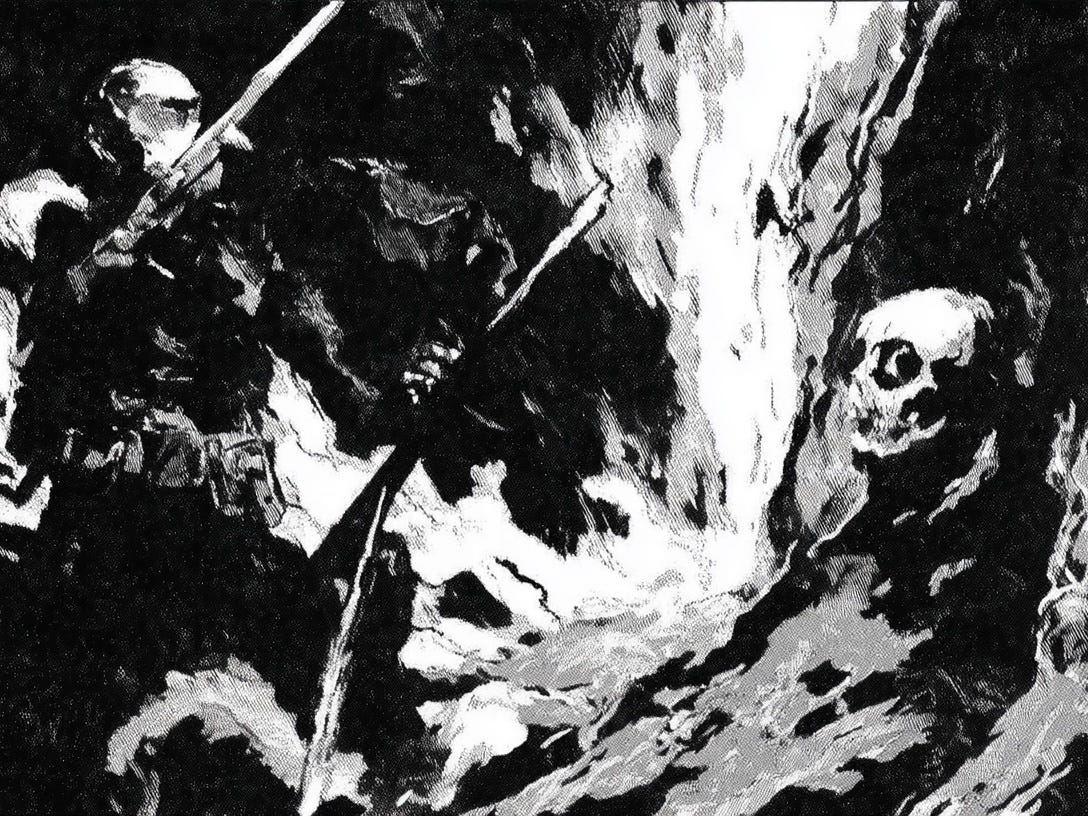
This piece is free to read without a subscription. It is a review of the novel Berserker Club by J David Osborne. This piece was commissioned by Futurist Letters as part of our initiative to provide more critical coverage of alt lit.
Berserker Club is a novella about metamorphoses. The TL;DR of it is, a bunch of freaks in a compound plot against the government but end up turning on each other, not without the aid of a sci-fi serum that turns them into Jungian hell golems. It’s kind of like Monster High, if you’ve seen that…
Okay, it’s not really like Monster High. But it is about metamorphoses. Not the classic Ovidian kind or the Kafkaesque, existential kind, but something messier. Confusing. The very discombobulation of the book’s characters, transmogrified by the powerful Berserker Juice into archetypes of their own psychic innards, is reflected in the reader’s own disorientation, a reaction to the sensory assault and repeated shock which Osborne’s book liberally metes out to us. It’s a disorientation which, I have to admit, I’ve grown unaccustomed to. There was a time, when I was in my halcyon era, that I would have lapped up Berserker Club like a vampire dog hungry for blood. Body horror was my bread and butter. I loved a good shunting;[1] The Texas Chainsaw Massacre was just a Tuesday. I’m different now, and at times as I read this exploitation drunken dream, I had to sigh out loud, ‘I’m too old for this shit.’ Literally, I mean—you’ll know what I’m talking about when you read the opening scene’s intestinal… no… I won’t even describe it…
Whether or not Berserker Club pushed my buttons, though, matters little. The author knows what he’s doing, and detonates the payload with severe accuracy. The work may not win with timid men like me, but for those who can still sit through Ichi the Killer (2001) or Tokyo Gore Police (2008) without having to contact an AI therapist afterwards, Berserker will be nothing less than a curl-up comfort read. That said, I’d wager the novella’s central themes are strong enough to intrigue those who are a bit less au fait with shlock and dismemberment, and for those who appreciate a well-paced plot regardless of the subject it’s likely to entertain.
Stylistically, Osborne is taut, cinematic, at times pulpy. His world draws on video games, memes, country music, conspiracy theories and a syncretic gumbo of mythology, all the while set in a scorched and vivid southwestern Oklahoma where the book’s cast of separatist militiamen are secretly encamped. A chief influence is Tokusatsu, a genre of Japanese film we might best describe as Power Rangers having a manic episode.
There are shades of Waco, Ruby Ridge and McVeigh in this underworld of radicals planning a terrorist insurrection, but the exact lineaments of the characters’ extremism are never spelled out. Osborne is thick into the action before we get a chance to ask any questions, and the premise is, anyway, a vehicle for the exploration of a timeless quandary about the contradictory powers of narrative.
Indeed, Osborne’s motley cast of extremists are portrayed as a collection of people who have brought themselves to a dark place by telling themselves the wrong stories in the wrong ways. Their terror plan is borne of a desire ‘to control narrative, to defeat death, maybe to conquer the world,’ as confesses its mastermind, their leader Whitmer. There is another vision, another possibility for storytelling, however, which the author allows us to glimpse—one grown organically from ‘the soul connections of family and friends’ rather than technologised control-freakery.
This vision is expressed in several vignettes: it is described in one of the camp member’s reminiscences of childhood, it is explained in the sermonising of Native American animal spirits, and it plays out in the dreams of one especially ambitious jackrabbit determined to revenge himself on human beings. Berserker dramatises a war between what Osborne describes as the ‘louder…weaponized stories’ of modernity and these deeper ‘soul connections’. This struggle animates the book—an apocalypse in the true sense of revelation, as its guts and gore slide away and leave us with a stunned sense of shock at modern men’s foolish need for control.
The mutations Osborne narrates play out our culture’s anxieties; among these warped butterflyings, one of the novella’s most arresting visions is that of a mutant monster which the psycho militia member Jody becomes—a kind of fast-flickering TikTok scroll of a horror, phasing in and out of different fixed forms in a rapid jump-cut sequence of undiscipline. After taking the serum, Berserker Club’s characters become grotesqueries of what they were in life, and Jody, who had been a conspiracy theory-obsessed doomscroller, mutates into a nightmare embodiment of the fragmented and frenetic style of attention that the contemporary web induces.
“Depending on what’s going on deep down inside of them, well, that’s the story they become,” Whitmer explains, he the demented toxicologist behind the so-called Berserker Juice. Osborne describes how Jody “had become a kind of shifting emergence. Where armor and spikes were one second, there would be a lion’s face or a katana or a series of crystals the next.” When the monster is described as a ‘shifting mass of Story’, the word takes on the connotation of Facebook and Instagram’s so-called ‘Stories’. It’s in the battle between this hobgoblin of hyperlinked consciousness and another suprabeing—the young man Luke who is reborn by the agency of animal spirits from the forest as the ‘Revenant’—that a cosmic conflict between different kinds of stories is bloodily played out. In reply to Jody’s ravings, the Revenant rebukes him, ‘that isn’t a story’. We might well agree: can the dissonant algo-rhythms of the internet really be understood in terms of story? In the battle between a young man transformed into a spirit of vengeance by ancestral nature deities and the frenzied “shifting mass” of “the Jody creature,” Osborne explores the collision of the unfinished and disordered jumble of the internet with humanity’s oldest traditions of storytelling. Indeed, Luke, now “the Revenant,” would know what real, deep stories are about. As the Crow Spirit who enacts his change of form explains:
All men are born in the image of the Spirit…and so they carry a sliver of Spirit within. But all men are also born of the Demiurge, and that shadow travels with them. So anyone who drinks Whitmer’s Juice becomes an archetype of man’s own making. Not a creature of the forest, not a true being of the Story…just a hollow mutation, starving for control, violence, and violation.
It is difficult not to hear the echo of ‘White Man’ in the name ‘Whitmer’ and as the “balance of the land” cracks—is rent asunder—in Osborne’s novella, the anxious haunting of American settler society is animated as a Grand Guignol battle between mutants engineered by a madman in a bunker and the animal spirits of the forest.
The Revenant’s battle with the shifting mass of story known as the “Jody creature” is one among the book’s several meditations on the power and perils of narrative. In Berserker’s most slickly unpleasant transformation, Osborne examines sexuality and power and their links with the human desire for narrative. This metamorphosis sees Miller, an undercover FBI agent obsessed with online catfishes, get turned into the “Semen Demon,” an insatiable explosion of ejaculate desperate for sex. Determined to fuck any and everyone in sight, the Semen Demon is a coagulation of Miller’s worldly desires, the story of his life turned up to eleven. Just as the phantasmatic conspiracy theorising of Jody’s life precursored his becoming a living infinity scroll, the undercover agent’s addiction to online love-chimeras seeds his rebirth as an angry sex god, a parody of the unproductive fetish-sexuality of the internet, a creature of porn and transnational romance scams. The white demon’s sexuality is only violent, only about control. The semen demon is Osborne’s Goya painting of modern tech’s phallocracy, its pure Will to Power.
Amidst all this, the author mirths about our oversaturated, cannibalising mediasphere with its relentless reboots, franchises and spin-offs: to destroy the cum god, the character Girard pours Berserker Juice into Miller’s severed pinky finger. “There’s one thing that will kill a Story faster than you can imagine,” he says. “Sequels.” So Osborne riffs on the way stories that become detached from nature, from soul connections, are not only evil but boring. They lose whatever enchantment they might have had, becoming mere copies, heartless spectacles in the age of mechanical reproduction. “That’s my sequel?…It doesn’t even look like me,” the Semen Demon protests. Shape without form, the sequel has only a “surface resemblance” to the original, Girard explains. As stories go through the churn of commercial reproduction, they lose their spirit, their substance.
At a deeper level, Berserker Club plays out the conflict between human creative hubris and the transcendent: on the one side there is Whitmer with his power juice, and on the other that stream of story which is the humming of nature itself. Like Shiva dancing the universe into being, reality is at base a game, a kind of story, in Osborne’s vision. Thus in one scene two siblings are described as playing an ‘infinite game…until the end of time’, one not reducible to the human narratives, those stories we create in the effort to make sense of and control life. Rather, we are played by the infinite cosmic game, rather than mastering it—we have to ‘let it be’, and ‘ride that current’, Osborne suggests. Thus in its gory interrogation of this theme, Berserker Club must stand as a tale for our times: when we walk towards the brink of artificial superintelligence, what argument do we have against the transhumanists unless we stake our faith in the power of a story which we humans do not tell, program or compute, but which sings itself through us?
Osborne’s philosophy of story is reflected in his own literary approach: he allows a world to grow organically, in thickets and shrubs and accidents. This gives his book a spontaneity that keeps the reader questing and moving in an uncertain landscape. In the tangle, though, he offers us embers of hope, nearly put out; the novella has a humming moral undertow in the vision of a better kind of story, one built on spirit and “soul connections,” utterly unlike the domineering violence of the militia monsters. He delineates a conflict between these soul bonds and the “slow abuse of louder stories, weaponized stories,” a metaphor that comes alive in the novella’s machine gun-wielding metamorphs.
In a crucial flashback scene, Osborne shows us how stories can be rekindled in the wreckage of technological devastation, a strange optimism. Two teenaged brothers have fled from their home as it is destroyed by a tornado. Wrenched away from the video game the older brother had been playing (nature fighting back), they hesitate together in a newly shattered universe. There the older spirit of story makes its return. “So what we do we now?” Cameron asks his brother:
Luke crouched down on the sidewalk and picked up a handful of acorns and twigs. He held them out to his big brother. “We invent a game.”
This sense that a new life can be built again in the wake of the depravity produced by untrammelled techno-hubris reverberates in the book’s closing images of an honest man delivering a rescued dog, Daisy, to the now-dead Whitmer’s estranged family. In Berserker Club, we are not given redemption. But we are told that if there is hope, it lies with the acorns, the twigs, and the daisies.
Hope springs, then, even in such a blood-drenched, Tokusatsu Western.
[1] Shunting is something rich people do, according to the 1980 movie Society, dir. Brian Yuzna.

