

This piece is free to read without a subscription.
A kid in the 1910s sees a weird, old mansion on a hill. It’s three stories tall, with steep roofs, and everything’s crooked. Maybe there’s a creaky old husband and wife left inside, or maybe just a widow. Our kid and his buddies have some vague, shapeless sense there used to be joy inside, but they can barely believe it. The staff door hasn’t been used in decades. Servants are too expensive to keep. Modernism is in, way in, and Victorian excess is out. The thing is in hopeless disrepair.
The winds of national change had guaranteed the ruin. Victorian manors had been overbuilt, and they could not last. They were made for large families, and they required constant labor to sustain. The economics of advancing industrialization and the rising price of labor had rendered them unaffordable. Having staff in an increasingly prosperous America was subject to the Baumol effect like anything else. Equality had flattened the Victorian.
So, they rotted, with mothballed aristos calcifying inside. Thus the haunted house as an archetype was born, immortalized in a Modernist Gothic continuation through the birth of cinema and through the midcentury. The Victorians loomed large for decades, eerie masses on the edge of town until by the seventies they’d all either been bulldozed or revived à la San Francisco’s Painted Ladies.
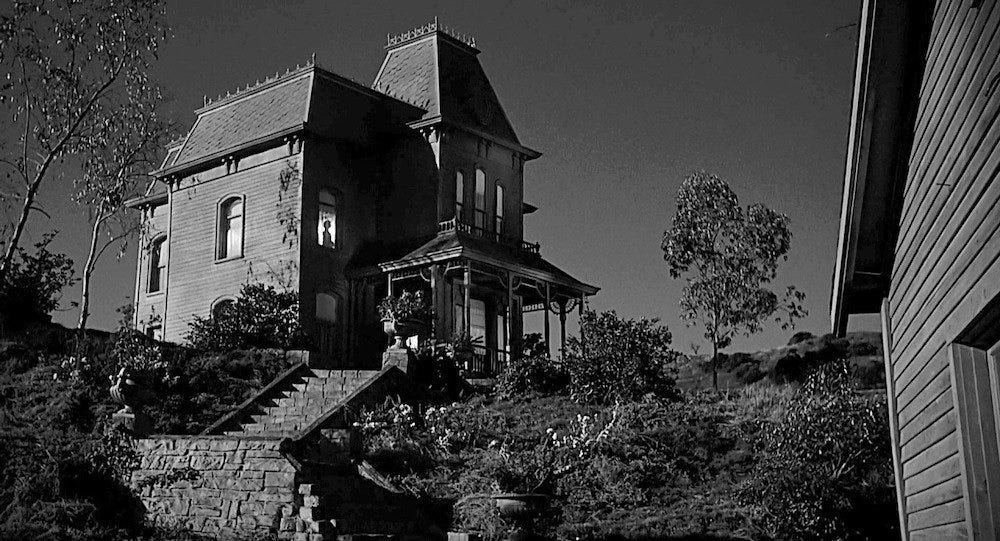
After that, the literary symbol lost touch with reality. It became a mythic image, one you only find in theme parks, still potent but ever more cartoonish, the domain of Luigi and Eddie Murphy and Scooby-Doo. No kid today wakes up terrified at night because of a decrepit Victorian up the street.
He’s still losing sleep, though. He’s just thinking of Backrooms.
In his earliest memories he sees images of vibrant malls and offices, just before the Great Recession crushed them. These visions mix with movies in his head until it all seems surreal. Then he looks out the window of mom’s car and sees an enormous tower or sandstone complex sitting abandoned like a pagan temple.
This is not a historically typical environment in which to grow up. A less code-restricted society would have repurposed the massive structures years ago, and a less financialized one would never have overbuilt so fast. The ur commercial complex of the late twentieth century, though is, a true gargantua. It is bigger than his school. It’s bigger than the Parthenon. In any other age it could house a small society, but it’s sitting there dead. Inside, carpet and slick floor and blank walls go on forever like the underworld.
It’s not difficult to piece together that the emergent cultural phenomenon of the Backrooms is a way of processing the aftermath of the commercial property collapse in the wake of digitalization. The original Backrooms image, after all, is from the inside of a shuttered furniture showroom. The people it would have hosted decades ago are now shopping on Houzz. It is a temple with no patrons, a corpse with asbestos in the walls.
Malls have held cultural cachet for America’s youth for decades. Unlike Millennial and Gen X mall nostalgia, however, Gen Z’s liminal craze does not foreground the good times. If Stranger Things’ Starcourt Mall is The Secret Garden, the Backrooms is The Haunting. There is no sober focus on what these places once were in Gen Z lore, just as Raiders of the Lost Ark is not particularly interested in helping us imagine the ribbon-cutting day of its trap-laden South American temples. It’s as if the Backrooms-esque world of empty offices came into existence fully formed and already obsolete at the moment of our frightened kid’s first memories.
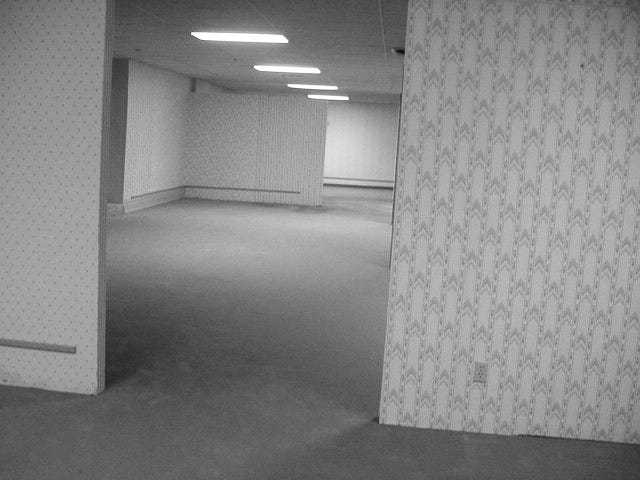
It’s not just the macroeconomics of overbuilding and decay, of course, that have caused Victorian manors and commercial complexes to share common cultural ground. They both have physical features that inherently lend themselves to horror. At their cores, they are large structures physically separated from adjacent buildings that contain maze-like, repeating interiors where it’s all too easy for an unfamiliar interloper to lose track of the front door. Since the time of Theseus, we have known the potent psychological power of a labyrinth. Cave systems, no doubt, were enticing and scaring little hominid children long before the beginning of recorded history. The potential was baked in. It just needed a little mildew and flickering light to really start hitting.
What, then, can we guess about the future of malls and office parks from the history of Victorian manors? We can guess most will be torn down, and the rest will be preserved by historical societies or renovated into something chic. We can also guess that the archetype of the Backrooms-style abandoned corporate space will persist long after they stop existing in reality. It’s possible that many of the symbols associated with late-twentieth-century commercial Modernism, the carpets and the brown and the Helvetica, will come to be more associated with horror as a genre than with early globalization and nine-to-fives.
There is, however, a counter argument. Late Modernism cemented itself, literally, in our society through civic buildings and community colleges with far more longevity than Victorian manor aesthetics. Perhaps those stubbornly undying examples will keep the liminal aesthetic from fully becoming pulp fodder. Another key difference is the fact that the Backrooms phenomenon is digitally mediated, meaning the simulacrum can move rapidly away from the signified phenomenon and become something broadly divorced from reality. The way you get into the Backrooms, after all, is by noclipping. This is not imagery born of sneaking into an abandoned mall with your buddies. It’s the imagery of playing a spooky video game.
Already, the Backrooms have gone far beyond just a haunted office story. They are infinite, as if procedurally generated. They are born of creepypastas and the SCP mentality, and in many ways they feel more like a metaphor for the darker side of the internet than an exploration of commercial decay.
The true course of the future, as usual, will be a mixture of all these facts and new elements yet unknown. That’s why we say the future rhymes, not that it repeats. What’s guaranteed, though, is that Gen Z and Gen Alpha are being permanently imprinted with the aesthetic sense that windowless, banal hallways and offices contain some malevolent force. “Backrooms!” the kids already yell with frightened delight in the basement ballrooms of a near-empty Marriott, and Mom and Dad just smile and nod along. Mom and Dad, after all, remember the twentieth century. They remember life and smiles in these rooms.
It’s just an old house on a hill. How scary could it be?

Behind the Scenes
As part of our commitment to keep all our essays and stories free, we ask our authors to pull back the curtain and share a little bit about their writing process and intent as a bonus for paying members.
You can find an explanation and reflection from the author of this piece just below…