

This piece is free to read without a subscription. It originally ran in Hyun Woo Kim’s personal publication Requests of Literary Exile. We are honored to run it here.
The story was conventional. It was also overly melodramatic and obscene. César de Hoz pondered whether he should read Aleksandr Yusupov’s story again. In Yusupov’s manuscript, César had already left some marks on the parts that should either be revised or removed. One of them was a scene where the story’s main character, Dolores, had sex with Don Camilo. She was being choked, her moans muffled, while her infant son Diego was asleep in the same room. Without doubt, Yusupov’s description of Dolores’ small breasts, which he likened to plums, had to be erased. The more serious problem was the scene itself. A mother was not supposed to be seen engaging in a sexual activity next to her son.
César raised his head. A clock hung on the wall, next to a small oval portrait of San Martín in a military uniform. It was a bit past seven in the evening. He had to leave soon and wanted to get the work done before heading out. Rubbing his eyes, César took out a cigarette. He closed his eyes and inhaled deeply.

Dolores believed that Don Camilo would financially support her and her son, but he was simply taking advantage of her. As Yusupov had briefly stated in a note attached to his manuscript, the story had its morals. It was an instructive tale for young girls of the city. The story’s publication could be approved after some edits. The inappropriate liaison between Dolores and Don Camilo could be implied just enough, not overtly shown. It could work the same with her relationship with Juan, Diego’s father. Nevertheless, something felt out of place. Yusupov was no radionovela scripter. His new story was not what César would expect from him.
César was about to begin working on a note for Yusupov when the writer’s last published story crossed his mind. It was a brilliant piece, whose main character and narrator was Cardinal Isidore of Kiev. In the story, the cardinal was trying to write a letter to Pope Nicholas V to report on the Fall of Constantinople. Having managed to escape from the pillaged Byzantine capital by taking off his cardinal’s robes and dressing up a corpse in them, Cardinal Isidore hesitated to write. What difference would his writing make when the Queen of Cities had fallen into the hands of the Mohammedan infidels? And who was he now to write, a shepherd who had left his sheep and run away, disguising himself as someone other than a cardinal? Before proceeding to further reminiscing and writing, the cardinal asked himself: But what difference will it make if I don’t write?
“Aleksandr, you son of puta!” shouted César, standing up and thumping the desk with his fist. His weak left leg trembled, and the cigarette dropped from his mouth. It left a burn on the first page of Yusupov’s manuscript. César grabbed his cane and stomped around the office. He could not get back to his seat out of anger. How could he fail to notice it? Cardinal Isidore stood for the writer Yusupov, and behind all those rich historical allusions and Modernist explorations of the human psyche, Yusupov was asking himself in front of the reader what use his writing had while he was living in disguise.
César’s left knee hurt. A handful of bullet fragments were still in there. Every moment his knee hurt, César wished that he had killed the guerrilla on the spot. People still called him Capitán De Hoz, but he was no longer a capitán. Now, being the only discharged officer in the city who knew Juana Inés was not some whore’s name, he was working as the censor of a state-run newspaper. A part of his job was monitoring journalists and writers in the city.
Yusupov had long been on his watch list. The middle-aged writer had never participated in political activism or published any social criticism, not even once. Considering his thirty-year-long career, it was surprising. His record was too clean, and the real ones always kept a low profile. Yusupov, however, could not outsmart César. He had once quoted a line from Neruda in a story of his. Just a line, but it was enough for César to notice it. He had also mentioned Solzhenitsyn once at a dinner hosted by the Anticommunist Alliance. The news of Solzhenitsyn he mentioned had been exclusively reported by The Times, a British newspaper whose import into the country was banned.
César sat down. “So, you think we are the Turks. Well played, Cardinal Alejandro, well played… There, I can still see your red robes… I knew we could never trust you Russians. You are all commies in the end… Aha, that was a smart move too, but Capitán De Hoz never misses a thing…” Murmuring under his breath, he reread Yusupov’s new story and took notes furiously. He could see every line in a new light. Dolores was the people, suffering between the regime and the rebels. Why else would there be two men in the story?
The clock struck eight. César noticed that the whole office had turned dark but for his desk, where a lamp was kept on. He limped towards the window and drew the curtains. It was raining. He was going to be late.
There were dilemmas, the first of them being that he had already approved Yusupov’s story on Cardinal Isidore to be published. He did not want to leave a stain on his career. Another was that Yusupov was good at hiding things—hiding his ideas and hiding himself. The ignoramuses of the army and the police would not be interested in what César had written in the notes, besides that Yusupov had written some pornographic scenes. He needed clear evidence that Yusupov was a commie, and no real commie writer was stupid enough to directly show in his work that he was a commie.
César put on a coat. Evidence could either be discovered or created. All he needed was some time.
“Capitán De Hoz, we were waiting for you!” Yusupov rose to greet César. Having learned Spanish in his teenage after immigrating with his father, he still carried a slight Russian accent. He had an unkempt, salt-and-pepper beard now. In a few more months, he was going to turn into either Tagore or Tolstoy. César remembered that the American CIA had advised Solzhenitsyn to grow his beard long, so that he would appear as a proper Russian sage. He wondered what lines Yusupov could have. For the plot César had in mind, KGB or MI6 would be nice. Anything Cuban could work, too. Those Cubans loved beards.
“Gentlemen, my apologies,” César said, taking his hat off and shaking hands with Yusupov, “but I was so lost in the story of the wonderful writer here, Señor Yusupov.”
César looked around. He knew all the journalists and writers gathered in this small hall that the local branch of the Anticommunist Alliance kept. He knew them better than their wives and mistresses. He was the one reading their unpublished works, reading deeply into their minds, and bugging them in their studies and bedrooms.
When one of them went missing, they rushed to César to ask about his whereabouts. They considered César to be their friend, and César was a friend of people who made journalists and writers disappear into thin air. He was their only hope in that he was the only man with some influence who genuinely cared about literature. What they did not know was that no writing man disappeared without César’s suggestion.
Sometimes, César visited abducted writers at the invitation of the authorities. The visit happened only when a writer would not give desirable testimony, even after one of his testicles had been crushed. A friendly face made anyone surrender with ease—when the inevitable death was nigh, writers stuck with their beliefs and silence, but when the prospect of survival glimmered, they instantly got better at constructing perfect narratives.
“How regrettable it is that I missed your speeches,” said César. Before he could hand his cane to a waiter, Tomás Barrera pulled out a chair for him. His seat was at the head of the table.
“Thank you.”
“My pleasure, Capitán. We are always pleased just to have you here, you see.” Barrera hurried to take away César’s cigarette and offered him a cigar. He was quick to act and dumb in his thoughts, as usual. All César wanted was a quick smoke before dinner. Still, César accepted the cigar with a smile on his face. There was no need to make things more complicated than needed. Idiots got scared when they did not have to and did not get scared when they should.
“Señor Iturri gave us a very poignant speech on the importance of literature for our nation and Christian civilization in general. Then I stepped onto the podium to read my recent investigative article on the disastrous effect The Little Prince caused among our children.” Barrera paused briefly in a dramatic manner to emphasize his importance, while Iturri politely nodded to César and César nodded back to him. Iturri was a man who ran huge oilseed plants on the outskirts of the city.
“You see, Capitán De Hoz, this degenerate book is contaminating the souls of our younger generation, our future. Recently, a young boy was seen catching birds in the General San Martín Park. He thought he would be able to fly away from our fatherland with the help of the birds, like the Little Prince did. He even skipped school. So, my point is that The Little Prince is a disquieting work of dangerous propaganda, spreading unpatriotic ideas, glamorizing antisocial vagabondage, agitating for blatant disrespect and affront to social hierarchy and authority, and the authorities should immediately consider a ban—”
“—I remember your article, Señor Barrera. It was an exemplary work of serious journalism,” César cut in, putting out the cigar. He just wanted to have his empanada in peace. A waiter brought provoleta, bread, and chimichurri sauce. César could smell the beef sizzling in the kitchen.
“Thank you, Capitán. It is an honor when a man of letters and a patriot like you remembers what I wrote.”
“And I believe Señor Yusupov was the last speaker, right?”
“Oh, yes-yes. He read an excerpt from a novel he is working on.”
César turned his face to Yusupov. He was having a glass of rich Malbec. César knew he loved Malbec. In an essay, he had made a light joke that he would never go back to Russia even if it became a Christian nation again, since he loved the local Malbec too much. Yusupov looked back at César and slightly raised his glass.
“You are working on a novel, Señor Yusupov?”
“Yes. Actually, I was thinking, it would be nice if it could be serialized in the newspaper. One chapter every Saturday evening, or two times a month, maybe,” Yusupov answered, wiping his mouth with a napkin. He still had chimichurri on his beard.
“Señor Yusupov, you should have consulted me. You know I am your biggest admirer in town, and we could definitely work out the serialization… What is it about?”
“It is about a capitán.” Yusupov gave a mischievous grin. “A Russian capitán. Did you know that the word, kapitan, sounds the same in Russian? The Russian capitán is an officer in the Imperial Russian Army, and the communist insurrection happens. He fights the communists by Baron Wrangel’s side, but fate brings him to Harbin. It is a city in Manchuria where many Russians live. Again, Chinese communists come, he fights them again together with the Chinese people, and he is forced to flee again, this time to South America, where he continues his fight against communists in the jungles, again and again…”
“A tale of indomitable anticommunist heroism!” Barrera interfered. He shook his fist in the air, and everyone gave thunderous applause. César desperately wanted to make every single one of them a Cuban sympathizer for a moment of silence. Steaks were served, and more wine was poured. After flan con dulce de leche accompanied by strong coffee, the band began to play Se dice de mí. It was time for the girls to enter. Tomorrow, César was going to interview them on whatever gibberish the writers and journalists said during the drunk tango. The Presidente was looking down on them in his portrait, hung high up in the hall.
César could not tango with one of the girls. It was not his professionalism, but his left leg. Then, he saw Yusupov sitting by himself. Come to think of it, Yusupov had never come to him when his colleagues had gone missing. Waiters were nowhere to be seen for the moment. Without his cane, César approached Yusupov. Yusupov noticed César limping towards him and helped him to a chair.
“Does your capitán have a son?” César asked Yusupov.
“Capitán De Hoz, I do not fancy inserting myself into my writing.”
“You don’t?”
“I don’t. Absolutely.”
They briefly listened to the tango without words.
“About your new story… I’m sorry for the bad news, Señor Yusupov, but I don’t think we can publish it. Too much obscenity.”
“Do you have suggestions for edits?”
“Technically, yes. I wrote all the notes already, but I decided not to bring them. The thing is, there are too many. I think it will be easier for you to just rewrite the whole thing, if you want that story to be published.”
“The reason is obscenity, am I correct?” Yusupov looked into César’s eyes.
“Yes, obscenity.”
“Obscenity only?”
César nodded. Now, it was Yusupov interrogating him. He made a firm decision that he would make Yusupov pay for his provocation. He took out a cigarette. To his surprise, Yusupov lit it for him.
“Just wanted to make sure what I should keep in mind when I work on it again, Capitán De Hoz.”
“The story caught me by surprise, to be honest. It did not sound like you.” César took a counter-offensive, puffing out cigarette fumes.
“Oh,” Yusupov exclaimed with a laugh. “You have truly keen eyes. It’s what happened to my wife’s hometown friend’s niece, and my wife’s idea of vengeance was disclosing everything in a nationally distributed newspaper, disguised as a work of fiction. The locals will know who they are, especially the local women, despite the pseudonyms.”
César pondered whether Yusupov was lying. Theoretically, a writer could come up with a story in an instant. Yusupov continued.
“To be honest, I felt a bit relieved to hear that you can’t publish the story. It’s not really my thing. I might work on it again, or not… but sometimes, you need to do things just to satisfy your wife. Thank you, Capitán, for providing me with, let’s say, the alibi.”
Yusupov’s mistress had told César that Yusupov seemed to be a good husband, no matter how ironic that sounded. What if he was telling the truth? He was stuttering more than usual, but it could have been because of the wine. César shook his head. He knew a commie when he saw one.
“What would I be without you, Capitán?” Yusupov muttered, placing his hand on César’s shoulder. “Really, Capitán, what would I be without you as my censor.”
His pronunciation of the Spanish word, censurador, was perfect.
Yusupov said there was no need to call for a taxi for him. He was going to walk. César knew his house was not within walking distance. It meant he was going to the apartment of his mistress.
César urged his chauffeur to drive faster. He needed to get there before Yusupov did. Before leaving the hall, César considered whether he should call Paula in advance to instruct her on what to say and ask. He decided not to. Sometimes, unscripted conversations yielded more precious evidence.
It was easy to find a mistress for Yusupov. All it took was to find an arrested college kid who had a charming enough girlfriend, dress her up, and make her appear in front of the writer at the right moment. Paula was not only charming but also smart. She understood very well what her job was, what a writer would want to hear from a young girl, and that her boyfriend was still under surveillance.
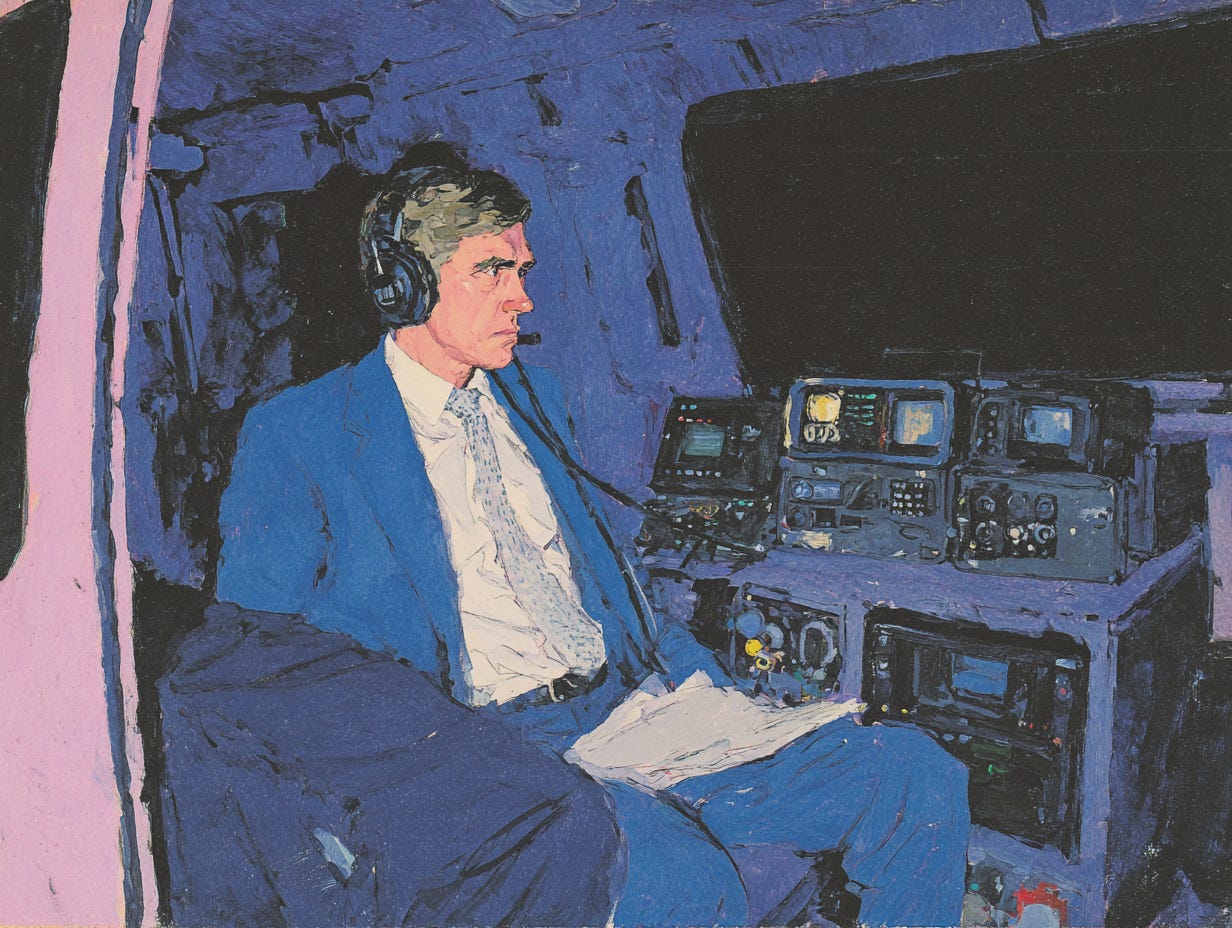
César could have waited for the report on what Yusupov said in the apartment as he usually did, but tonight, he wanted to hear it all with his own ears. He still felt enraged when the chauffeur stopped the car behind the apartment building. A black van was parked about ten meters away. The rain had gotten heavier, and the short walk was enough to get César soaked. The soldier in the van, though surprised when César knocked on its door, handed him headphones without saying anything. César heard Paula’s footsteps.
Soon, Yusupov entered Paula’s apartment. He called her Sonia, the name César had given her. It was a name too befitting to a Russian writer’s mistress. Yusupov did not know everything that had happened between him and the girl was too smooth to be true. His ignorance gave César a sense of superiority. Hearing Yusupov’s voice, he sneered.
It seemed Yusupov was drinking more wine. He mentioned Gogol, Bulgakov, Rubén Darío, and Kafka. Everything he talked about them did not make much sense. Nonetheless, Paula was doing an impressive job, as always. The writer wanted his mistress to be intelligent enough to recognize the other writers he spoke of, but not too intelligent. A writer’s mistress should be able to agree with whatever he said with witty comments, but should not actually have her own opinions. It was a delicate art to flatter Yusupov without letting him know he was being flattered.
“And who’s the worst of them all? Borges, darling, it’s Borges. He still lived with his mom when he was almost eighty. Maybe he was fucking their housekeeper all those years, believing his mommy didn’t know, but I guess you shouldn’t hurt your blind son’s feelings, right?”
César tried to focus again on Yusupov’s words. At last, the slick commie was talking about someone alive.
“Did you know the name of Borges’ housekeeper was Fanny? Fanny, and he talks about his love for the English language. Sure, he loved some fanny,” Yusupov continued.
“What do you mean?”
“Never mind. The thing is, Borges says he’s writing fiction, not fables... Does he even understand what he’s talking about? Not at all. No one can, because there’s nothing he’s really talking about, but who cares? Just go blind, be like Homer, and write something that sounds profound, express your Anglophilia… Then all damn Yankees rush in to explain why your writing is so important. Even you could get big like Borges with some tricks, Sonia. Since you are a girl and studying at college, let’s say, if Isabel Allende weren’t on Pinochet’s wanted list—”
“—Are you saying that Borges is ignoring our social realities?”
César stopped breathing, excitedly anticipating Yusupov’s answer. Paula was seriously talented. She asked a perfect question at a perfect moment and even managed to loosen the slick commie enough to let the name Allende out of his mouth.
“Who cares about that son of puta, darling,” Yusupov said. César lit another cigarette and cursed.
“Yes, I think you are much more talented, obviously. I think you must be the best writer on this continent, in fact.”
“You think so?”
Yusupov and Paula clinked their glasses. César heard Yusupov’s hearty laughter and cursed again. All writers were whores.
“What does De Hoz say about your new story?”
Paula’s question was unexpected. She could be merely asking about Yusupov’s day, but César felt that Paula was daring both him and the writer. A moment passed in silence. The sound of the rain squeezed in through the vacuum.
“How can I say this… I can see that De Hoz always tries his best to read everything closely, to interpret everything. It might be a good thing. Good for me as a writer, I guess. He takes literature very seriously. Perhaps too seriously.”
Cigarette ash fell on César’s left knee.
“Darling, I’m not here to talk about work with you. I do that with De Hoz. Now, show me your plums.”
From then on, César listened to Yusupov making out with Paula and roughly pushing her all the way to bed. The soldier next to César grinned at him, but he just felt numb.
“Say my name, you puta, say my name!”
“Don Alejandro! Don Alejandro!”
Paula’s moans suddenly got muffled. César could picture Yusupov choking her. He closed his eyes in agony. He could not imagine what he would be without his writer.

Behind the Scenes
As part of our commitment to keep all our essays and stories free, we ask our authors to pull back the curtain and share a little bit about their writing process and intent as a bonus for paying members.
You can find an explanation and reflection from the author of this piece just below…
